
De wereld van autoriteit toont zijn lelijkste gelaat. Het is een tijd van de botste machtspolitiek, ongebreidelde plundering van de aarde, onderwerping van het leven aan technologie, digitalisering en economische efficiëntie. We worden geconfronteerd met de ultieme uiting van de brutaliteit van de staat: algemene militarisering en oorlog.
In plaats van ons uit angst of verslagenheid terug te plooien of te kiezen voor het minste kwaad, kiezen we voluit voor onze anarchistische ideeën en antiautoritaire ethiek. Geen knieval dus voor politiek en compromissen maar een zoektocht naar onze mogelijkheden voor autonome strijd met onze drang naar vrijheid als kompas.
In een wereld waarin staatsgeweld en autoritarisme welig tieren, is ons feest van analoog verzet en solidariteit meer dan ooit een noodzaak.
Op de anarchistische boekenbeurs vind je een ruim en divers aanbod aan boeken, publicaties, t-shirts, posters en stickers. Je kan er snuisteren tussen oude romans, revolutionaire klassiekers en nieuwe uitgaven van verschillende distro’s. Van filosofische werken tot strijdvoorstellen.
De boekenbeurs is meer dan alleen een plaats om je boekenverzamelzucht bot te vieren. Het is een plaats van uitwisseling en discussie, een plaats waar ideeën, individuen en collectieven elkaar kunnen ontmoeten en vinden in affiniteit.
Zo wordt de boekenbeurs een plaats waar oproepen tot sociale strijd, via discussie en informele ontmoetingen nieuwe inspiratie, zuurstof en dynamiek krijgen.
Welkom op 9 en 10 mei 2026 op de boekenbeurs!
Tot dan en leve de anarchie!
Contact: abgent(A)riseup.net
Op de boekenbeurs kan je enkel met cash betalen, toegang is gratis
The 22 edition of the Anarchist Book Fair in Ghent
The world of authority is showing its ugliest face. It is a time of the crudest of power politics, unbridled plundering of the earth, the subjugation of life to technology, digitalisation and economic efficiency. We are confronted with the ultimate expression of state brutality: universal militarisation and war.
Instead of folding back out of fear or defeat, or choosing the lesser evil, we fully embrace our anarchist ideas and anti-authoritarian ethics. No kneeling before politics and compromise, but a search for our possibilities for autonomous struggle, with the desire for freedom as our compass. In a world where state violence and authoritarianism run rampant, our gathering of analogue resistance and solidarity is more necessary than ever.
At the Anarchist Book Fair you will discover a wide and diverse range of books, publications, t-shirts, posters and stickers. Rummage in old novels, revolutionary classics and new editions from various distros. From philosophical works to proposals for struggle.
The book fair is more than just a place to indulge your book-collecting urge. It is a place of exchange and discussion, a place where ideas, individuals and collectives can meet and find each other in affinity. This way the Book Fair becomes a space where calls for struggle, through discussion and informal encounters, find new inspiration and momentum.
Welcome on the 9th and 10th of May 2026 at the Book Fair. Until then — long live anarchy!
Contact: abgent(A)riseup.net
The Book Fair is a cash only event, admittance is free.
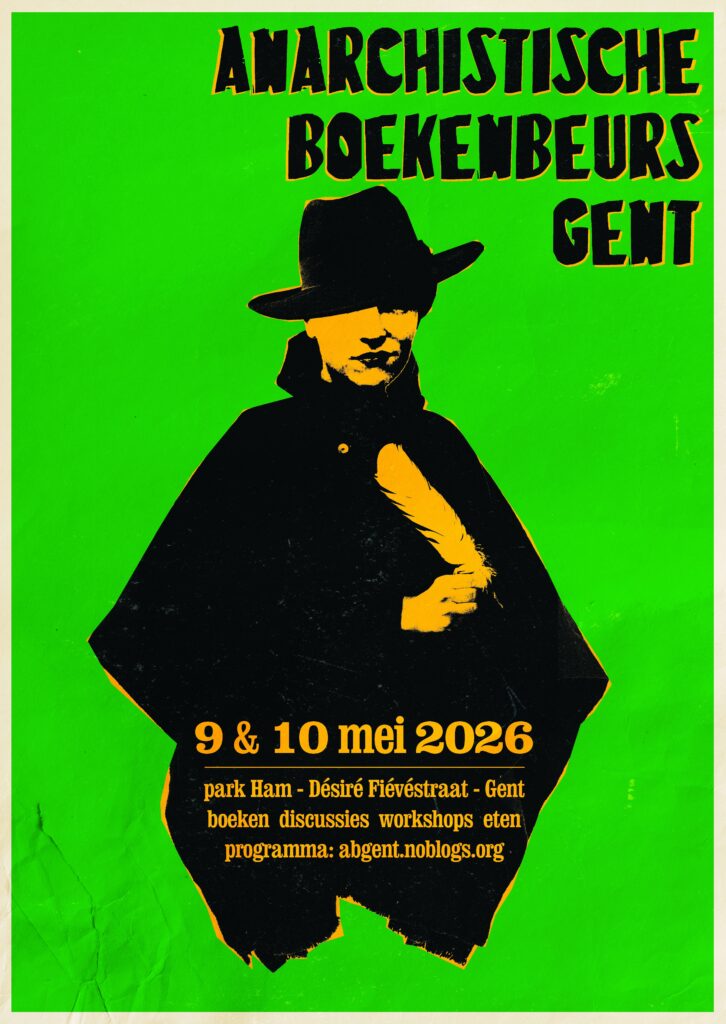
de posters zijn er!
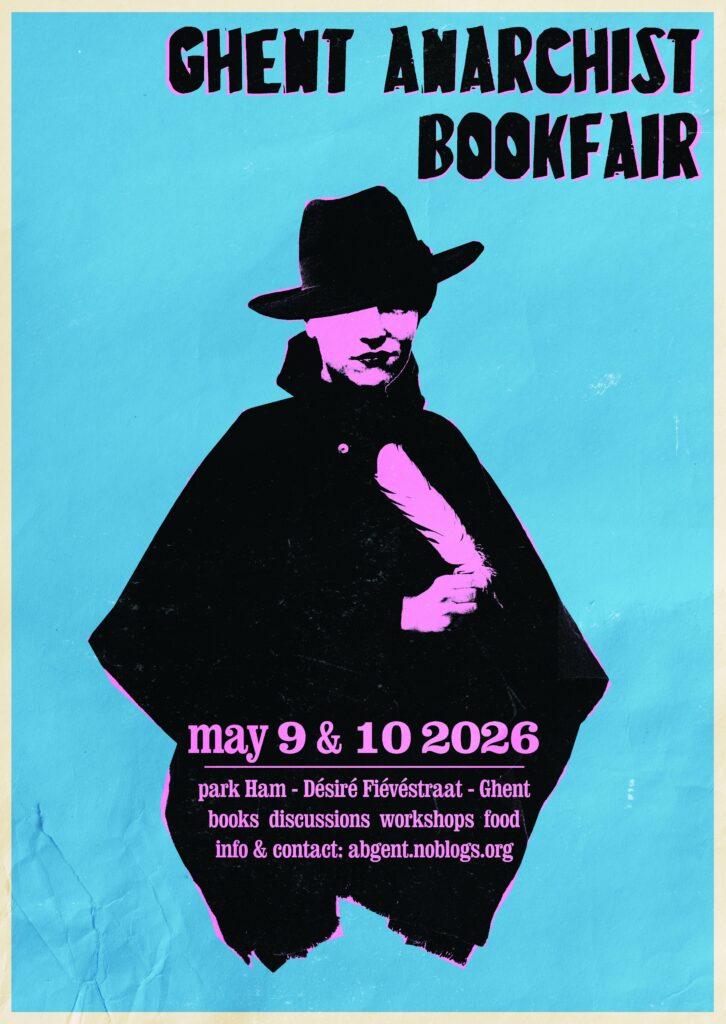
posters are here!
ONLY CASH EVENT
(archief 2025) 17/05 13:30 Discussie!
Anarchisten tegen de militarisering
‘If we must fight, let it be for the social revolution’ – Emma Goldman
Militarisering is terug van nooit weggeweest. In sneltempo marcheren de staten richting een veralgemening van oorlogssituaties, in de eerste plaats om hun macht te vrijwaren. In hun kielzog rukt een heel militair-industrieel complex enthousiast mee op: investeerders, industriëlen, banken, universiteiten en techbedrijven wrijven zich in de handen bij zoveel opportuniteiten.
De andere kant van de medaille is voor de onderdrukten overal ter wereld. Zij ondervinden alle mogelijke verschrikkingen van oorlog aan den lijve: de directe vernietiging van levens en leefomgevingen, maar ook de verstrakking van de greep van de autoriteit, disciplinering, verarming en verlamming door angst.
Wat kunnen we beginnen tegen de algemene militarisering van de samenleving, tegen hoogtechnologische wapens en miljardenbudgetten? Sommigen stappen uit wanhoop mee in een militarisme dat het minste kwaad lijkt, anderen bekritiseren elk militarisme maar lijken moeite te hebben om die kritiek concreet te maken en nog een groep (misschien de grootste) lijkt verlamd te zijn door een gebrek aan strijdperspectief.
In deze discussie gaan verschillende sprekers vanuit een consequent antimilitaristische houding op zoek naar mogelijkheden om hier en nu initiatieven te ontwikkelen. We proberen te begrijpen wat militarisme is en hoe het zich manifesteert. Tenslotte kijken we naar enkele historische en actuele voorbeelden van anarchistische strijd tegen militarisme.
Op de discussie wordt ook een infotafel met leesmateriaal voorzien.
Militarisation is back like never before. The States are marching towards a generalisation of war situations, first of all to safeguard their power. In their wake a military industrial complext is enthousiastlcly running along: investorss, industrials, banks, universities, and techcompanies rub their hands in the amount of opportunities that enfolds before htme. The other side of this medal is the oppressed everywhere in this world. They encounter all the possible horrors in person: the direct destruction of lives and environments, but also the thightening of the grip from authority, discplinations, impoverishment, and paralysis by fear.
How do we commence a fight against a general militarisations of society, against high-tech wapenory, and billion dollar budgets? Some go along out of desperation, thinking of militarisation as the lesser evil, other criticise every militarism, yet seem to struggle with making it concrete, and another group (maybe the biggest one) seems paralysed, by a lack of battle persepctive.
In this discussion different speakers will, from a consequent anti-militaristic attitude, search for possibilities here and now to develop initiatives. We try to understand what militarisation is , and how it manifests itself. To close, we will look at some historical and actual examples of anarchistic battles against militarisation.
There will be a info table available with reading materials.
(archief 2025) Food & Music
Food will be provided by the amazing Kokkerellen collective! Expect delicious sandwiches on Saturday & Sunday, combined with diner on Satudary evening.
Saturday evening diner will even be accompanied with music by Buterflai!
Everything is vegan and paid by free contribution (cash!)
Eten wordt voorzien door het geweldige Kokkerellen collectief! Verwacht je aan heerlijke broodjes op zaterdag en zondag, samen met een avondmaal op zaterdagavond.
Tijdens de avondmaal van zaterdag is er ook muziek voorzien door Buterflai!
Alles is vegan en betaald met een vrije bijdrage (cash!).
La nourriture sera fournie par l’incroyable collectif Kokkerellen ! Attendez-vous à de délicieux sandwichs le samedi et le dimanche, ainsi qu’à un dîner le samedi soir.
Pendant le dîner du samedi, la musique sera également assurée par Buterflai !
Tout est végétalien et payé avec une contribution libre (argent liquide!).
(archief 2025) Program update!
Zaterdag/Samedi/Saturday
10:00 – 13:00 OPEN spontaan in te vullen – combler spontanément – to fill up spontaniously
13:30 – 15:30 Anti-Militarisme
16:00 – 17:00 Boek presentatie: “Met getrokken dolken” – Presentation du livre “à couteaux tirés” – Book presentation “At dagger’s drawn”
Evening is filled with food from Kokkerellen & concert by Buterflai
Zondag/Dimanche/Sunday
10:00 – 11:00 OPEN spontaan in te vullen – combler spontanément – to fill up spontaniously
11:30 – 13:30 Het belang van anarchistisch publiceren – l’importance du diffuser les publications anarchistes – the importance of anarchist publications
14:00 – 16:00 Vechten tegen de megamachine – Lutter contre la méga-machine – Fighting the mega-machine
(archief 2025) Tranche D’Anar ce soir à 20h30!
Ce soir les personnes du Tranche d’Anar vous présentera le foire du livre anarchiste!
Radio Air Libre – Foire du Livre Anarchiste à Gand 17 et 18 mai – Tranche d’Anar
“Salut! Ce mercredisoir 7 mai à 20h30 à l’émission Tranche d’Anar on vous présentera le foire du livre anarchiste à Gand qui aura lieu le weekend du samedi 17 et dimanche 18 mai 2025, il y aura des stands de livres, brochures, fanzines etc, mais aussi des ateliers de discussions. Ensuite on vous diffusera une partie de la discussion sur la militarisation et re-armement de l’ Europe qui a eu lieu à Garcia Lorca le samedi 26 avril pendant le festival au soutien au 1 er mai révolutionnaire. On diffusera l’explication de la militarisation et re-armement de l’Europe par C.Wasinski (politologue à l’ULB) et par D.Brosteaux (autrice du livre “Les désirs gerriers de la modernité”), Et On terminera avec l’agenda militant de stuut.info”
(archief 2025) 17/05 16:00 Book presentation!
At Daggers Drawn with the Existent, its Defenders and its False Critics is a text which above all else, makes several decisive breaks. It was the fruit of the experiences in and around the anarchist weekly Canenero, which, it should be remembered, was an adventure which comrades undertook from 1994-1997: years which were marked in this context by wave upon wave of repression not just from the infamous Marini frame up, but also from large swathes of the anarchist movement in Italy who would never pass on an opportunity to dig trenches between themselves and those anarchists who had retained the ‘bad habit of attacking power’ in those years. In the broader context, this decade saw the firm consolidation of tendencies in capitalism which were being tentatively analysed by comrades in the preceding decade: the total eclipse of the worker-based struggle, the full retreat into ossified solipsism of the armed struggle organisations, and the growing confidence in citizenist ‘participation’ in society in the form of alternativist ghettos approved tacitly or officially by the state, symbolised by in Italy the prevalence ‘legalised’ squats, ‘social centres’ etc.
What was distilled in At Daggers Drawn can be thought of as a subversive alchemy which anarchist comrades who avail themselves of means, analysis, perspectives, in short a ‘project’ are always capable of: the possibility to turn these conditions upside down – to turn a repressive atmosphere into an offensive perspective, to turn profound isolation into the basis for a search for accomplices and affinity, to turn a moment characterised by general resignation, surrender and betrayal into an occasion for rediscovery and elaboration of the wildest, audacious elements of anarchism. It is the rough and thorough clarity of these intuitions, the proud negations, the opening of perspectives which are really incompatible with authority which has made this little book sing and resound in the hearts of comrades all over the world whose need to perform the same kind of alchemy in different conditions hasn’t receded an inch since the book’s anonymous emergence.
So why return to it now? Because despite the wide reach and notoriety of the book there has been a decades-long process of slow revisionism of these harsh breaks which the comrades who contributed to its tumultuous context struggled with all their passion to make. The ideas of the text have been the first casualty. They have found themselves exalted one moment, derided in the next (often in the mouths of the same comrades) and put together with all kinds of random elements from the autonomous movements from which they decisively broke and with which they have nothing in common. They have been continually described as ‘inaccessible’, and consequently put to one side for more appealing, marketable ideas and perhaps worst of all, they have been generationally and opportunistically forgotten.
In truth, this is something which has always taken place in anarchism, the attempts (more or less pronounced) to slowly take the anarchy out of anarchism in order to adapt it to the quotidian needs of the moment (or movement). But it has always been a sign of health, a vital sign of struggle, when comrades have felt the need to reverse this procedure: to uncover again the subversive charge of their own ideas, that which makes them intransigent, singular and unaccommodating to all kinds of political pragmatics. Out of this can come the perspective finally, not to lower oneself to the level of the gutter that the defenders and false critics of the existent always sell as the ‘reality’ we are obligated to swim in to survive, but to courageously risk an uprising of the arms and mind whose raison d’etre is the conquest of a life worthy of living.
All the more reason then to aggressively double down on these unique and refractory ideas today, those which – despite everything – continue to have a propulsive and revelatory quality in the lives of so many anarchist comrades with bad temperaments and intentions. After all, how many days and nights have the ideas of this little book both intoxicated and carefully reasoned through in our seething minds in their thirst for points of inspiration to embolden our struggles? So in this presentation-discussion, whether it is a revisiting or an encounter for the first time, let’s throw a few of them onto the table, with any luck smashing fine china out the way and reducing gossip and pub-talk to silence, and without any apology whatsoever let’s reopen this pandora’s box!
A few ideas:
1. The open possibility of consistent and determined anarchist intervention in social reality without passing through any kind of vanguardism, sollipsistic self-regard or reformist populism.
“But who said it is not possible to talk to the unemployed of sabotage, the abolition of rights, or the refusal to pay rent (whilst practising it at the same time)? Who said that when workers come out into the streets on strike, the economy cannot be criticised elsewhere? To say what the enemy does not expect and be where they are not waiting for us. That is the new poetry.”
2. The method of ‘breaking up and putting back together again’, as a proposal of attack and intervention which concretises the totality of domination in precise places and times without diminishing the former, or abstracting and mystifying the latter.
“Criticising technology, for instance, means considering its general framework, seeing it not simply as an assemblage of machinery, but as a social relation, a system; it means understanding that a technological instrument reflects the society that produces it and that its introduction changes relations between individuals. Criticising technology means refusing to subordinate human activity to profit. Otherwise we would be deceiving ourselves as to the implications of technology, its claims to neutrality, the reversibility of its consequences. It then becomes necessary to break it up into its thousand ramifications, the concrete realisations that are increasingly mutilating us.”
3. Individual action as non-contradictory to collective moments of revolt: autonomous, independent attack as a condition of possibility for social upheaval and transformation.
“the method of spreading attacks is a form of struggle that carries a different world within it. To act when everyone advises waiting, when it is not possible to count on great followings, when you do not know beforehand whether you will get results or not, means one is already affirming what one is fighting for: a society without measure. This, then, is how action in small groups of people with affinity contains the most important of qualities—it is not mere tactical contrivance, but already contains the realisation of one’s goal. […] Anyone who starts screaming that it is no longer—or not yet—time for rebellion, is revealing the kind of society they want in advance. On the other hand, to stress the need for social insurrection now — an uncontainable movement that breaks with historical time to allow the emergence of the possible – simply means: we want no leaders”
4. To be finally done with all politics, left and as much as right, democratic as well as radical: against the tired cliché of the armed party as much as against the moronic possiblism of the citizenist social movement managers.
“For its part, the State has every interest in reducing the revolutionary threat to a few combatant organisations in order to transform subversion into a clash between two armies: the institutions on the one hand, the armed party on the other. What power fears most is anonymous, generalised rebellion. The media image of the ‘terrorist’ works hand in hand with the police in the defence of social peace. No matter whether the citizen applauds or is scared he is still a citizen, i.e., a spectator.
The reformist embellishment of the existent feeds armed mythology, producing the false alternative between legal and clandestine politics. It suffices to note how many sincere left democrats are moved by the figure of the guerrilla in Mexico and Latin America.Passivity requires advisors and specialists. When it is disappointed by the traditional ones it lines up behind the new.”
5. The all out attack on the existent as a perspective to encounter accomplices amongst those who don’t want to be part of incontinent political mobilisations, but to break out of an insufferable life and settle some scores. Consequently, a reassessment of the ideal revolutionary conditions for the development of free life, away from the old idea of limiting chaos to the shortest possible period before a new social order is proposed, but rather a choice to abandon the well lit paths of the rapport de force, and enter the jungle of unmanageable revolt.
“If they do not wish to deceive themselves and others, those struggling for the demolition of the present social edifice must face the fact that subversion is a game of wild, barbarous forces. Someone referred to them as Cossacks, someone else hooligans; in fact they are individuals whose anger has not been quelled by social peace.
But how do you create a new community starting from anger? Let us put a stop to the conjuring tricks of dialectics. The exploited are not carriers of any positive project, be it even the classless society (which all too closely resembles the productive set up). Capital is their only community. They can only escape by destroying everything that makes them exploited: wages, commodities, roles and hierarchies. Capitalism has not created the conditions of its overcoming in communism—the famous bourgeoisie forging the arms of its own extinction—but of a world of horrors.
The exploited have nothing to self-manage but their own negation as such. That is the only way that their bosses, leaders and apologists in various guises will disappear along with them. In this ‘immense task of urgent demolition’ we must find joy, immediately.
For the Greeks the word ‘barbarian’ did not only refer to the stranger, but also to the ‘stammerer’, he who did not speak the language of the polis correctly. Language and territory are inseparable. The law fixes the borders enforced by the order of Names. Every power structure has its barbarians, every democratic discourse its stammerers. The society of commodities wants to banish their obstinate presence—with expulsion and silence—as though they were nothing. It is on this nothing that rebellion has founded its cause. No ideology of dialogue and participation will ever be able to mask exclusion and internal colonies completely. When the daily violence of the State and the economy causes the evil part to explode, there is no point in being surprised if someone puts their feet on the table and refuses to accept discussion. Only then will passions get rid of a world of death. The Barbarians are just around the corner.”
Met Getrokken Dolken tegenover het bestaande, haar verdedigers en haar valse critici is een tekst die vooral een aantal beslissende breekpunten maakt. Het is het resultaat van de ervaringen in en rond de anarchistische wekelijkse krant Canenero. Het was een avontuur dat kameraden ondernamen van 1994-1997; jaren die in deze context gekenmerkt werden door golf na golf van repressie. Niet alleen door de beruchte Marini-montage, maar ook door grote delen van de anarchistische beweging in Italië die geen kans voorbij liet gaan om loopgraven te graven tussen henzelf en de anarchisten die in die jaren de ‘slechte gewoonte’ hadden behouden om de macht aan te vallen. In de bredere context zag je in dit decennium de stevige consolidatie van tendensen in het kapitalisme die door kameraden in het voorgaande decennium voorzichtig werden geanalyseerd: de teloorgang van de arbeidersstrijd, de volledige terugtrekking in versteend solipsisme [zelfingenomenheid] van de gewapende strijdorganisaties, en het groeiende vertrouwen in de burgerlijke ‘deelname’ aan de maatschappij in de vorm van alternativistische getto’s die stilzwijgend of officieel door de staat zijn goedgekeurd, in Italië gesymboliseerd door de overheersende ‘gelegaliseerde’ kraakpanden, ‘sociale centra’ enz.
Wat gedistilleerd [geconcludeerd] werd in Met Getrokken Dolken kunnen we zien als een subversieve alchemie waartoe anarchistische kameraden die over middelen, analyses, perspectieven, kortom een ‘project’, beschikken altijd in staat zijn: de mogelijkheid om deze omstandigheden op hun kop te zetten – om een repressieve sfeer om te zetten in een offensief perspectief, om een diep isolement om te zetten in een basis voor een zoektocht naar medeplichtigen en affiniteit, om een moment dat gekenmerkt wordt door algemene berusting, overgave en verraad om te zetten in een gelegenheid voor herontdekking en uitwerking van de wildste, stoutmoedigste elementen van het anarchisme. Het is de ruwe en grondige helderheid van deze intuïties, de trotse negaties, de opening van perspectieven die werkelijk onverenigbaar zijn met autoriteit, die dit kleine boekje heeft doen zingen en weerklinken in de harten van kameraden over de hele wereld, wier behoefte om hetzelfde soort alchemie uit te voeren in andere omstandigheden geen centimeter is afgenomen sinds de anonieme verschijning van het boek.
Dus waarom er nu op terugkomen? Omdat er, ondanks de grote verspreiding en de bekendheid van het boek, een decennialang proces van langzame herziening heeft plaatsgevonden van deze harde breuken waarvoor de kameraden die hebben bijgedragen aan deze tumultueuze context met al hun passie hebben gevochten. De ideeën van de tekst zijn het eerste slachtoffer geworden. Het ene moment werden ze verheerlijkt, het andere bespot (vaak door dezelfde kameraden) en samengevoegd met allerlei willekeurige elementen uit de autonome bewegingen waarmee ze resoluut braken en waarmee ze niets gemeen hebben. Ze zijn voortdurend omschreven als ‘ontoegankelijk’ en bijgevolg terzijde geschoven ten gunste van meer aantrekkelijke, verkoopbare ideeën en misschien nog wel het ergste: ze zijn generatie op generatie en opportunistisch vergeten.
In werkelijkheid is dit iets dat altijd heeft plaatsgevonden in het anarchisme, de pogingen (meer of minder uitgesproken) om langzaam de anarchie uit het anarchisme te halen om het aan te passen aan de alledaagse behoeften van het moment (of de beweging). Maar het is altijd een teken van gezondheid geweest, een vitaal teken van strijd, wanneer kameraden de behoefte voelden om deze procedure om te keren: om opnieuw de subversieve lading van hun eigen ideeën bloot te leggen, datgene wat ze onverzettelijk, enkelvoudig en onaangepast aan allerlei politieke pragmatiek maakt. Hieruit kan eindelijk het perspectief voortkomen om zich niet te verlagen tot het niveau van de goot die de verdedigers en valse critici van het bestaande altijd verkopen als de ‘werkelijkheid’ waarin we verplicht zijn te zwemmen om te overleven, maar om moedig een opstand te riskeren van de wapens en de geest die alsbestaansreden de verovering van een leven heeft dat het waard is geleefd te worden.
Des te meer reden dus om deze unieke en weerbarstige ideeën, die ondanks alles nog steeds een stuwende en onthullende kwaliteit hebben in het leven van zoveel anarchistische kameraden met slechte temperamenten en bedoelingen, vandaag agressief te verdubbelen. Immers, hoeveel dagen en nachten hebben de ideeën van dit boekje onze ziedende geesten niet bedwelmd en zorgvuldig doorgeredeneerd in hun dorst naar inspiratiepunten om onze strijd te versterken? Dus laten we er in deze presentatie-discussie, of het nu een herontdekking is of een eerste ontmoeting, een paar op tafel gooien, met een beetje geluk het fijne porselein aan de kant schuiven en roddel en kroegpraat tot zwijgen reduceren, en zonder enige verontschuldiging deze doos van Pandora heropenen!
Een paar ideeën:
1. De open mogelijkheid van consistente en vastberaden anarchistische interventie in de sociale werkelijkheid, zonder enige vorm van voorhoede-denken, sollipsistisch zelfbelang of reformistisch populisme.
“Maar wie zei dat het niet mogelijk is om het met werklozen over sabotage, de afschaffing van rechten of de huurstaking te hebben – door tegelijkertijd tot daden over te gaan? Wie zei dat de economie elders kan bekritiseerd worden wanneer stakende arbeiders op straat komen? Te zeggen wat de vijand niet verwacht en te zijn waar ze ons niet opwachten. Dat is de nieuwe poëzie.” (p 36)
2. De methode van ‘uit elkaar halen en weer in elkaar zetten’, als een voorstel voor aanval en interventie die de totaliteit van overheersing op precieze plaatsen en tijdstippen concretiseert zonder het eerste te verminderen of het tweede te abstraheren en te mystificeren.
“Technologie bekritiseren, bijvoorbeeld, betekent het algemene kader in overweging nemen, het niet louter bekijken als een verzameling machines, maar als een sociale relatie, een systeem. Het betekent dat men begrijpt dat een technologisch instrument de samenleving die het voortbrengt weerspiegelt en dat de invoering ervan de relaties tussen individuen verandert. Technologie bekritiseren, betekent dat men weigert menselijke activiteit ondergeschikt te maken aan winst. Anders zouden we onszelf misleiden wat betreft de implicaties van de technologie, haar aanspraken op neutraliteit, de omkeerbaarheid van haar gevolgen. Dan wordt het noodzakelijk de technologie op te delen in haar duizend vertakkingen, in haar tastbare verwezenlijkingen die ons elke dag meer en meer verminken.” ( p. 32)
3. Individuele actie als niet-tegenstrijdig met collectieve momenten van opstand: autonome, onafhankelijke aanval als voorwaarde voor de mogelijkheid van sociale omwenteling en transformatie.
“De methode van verspreide aanvallen is een strijdvorm die een andere wereld in zich draagt. Tot de daad overgaan wanneer iedereen je aanraadt te wachten, wanneer het onmogelijk is om op een grote aanhang te rekenen, wanneer je op voorhand niet weet of je al dan niet resultaten zal boeken – dat op zich betekent al een bevestiging van waarvoor men strijd: een samenleving zonder maatstaf. Dat is dan waarom de actie in kleine groepen van mensen met affiniteit de meest belangrijke kwaliteit bezit – het is niet alleen tactisch vernuft, maar het bezit al de verwezenlijking van het doel. […] Gelijk wie begint te roepen dat het niet langer – of nog geen – tijd is voor rebellie, onthult op voorhand welke samenleving hij wil. Anderzijds betekent het benadrukken van de nood aan de onmiddellijke sociale opstand – een onbedwingbare beweging die breekt met de historische tijd om het mogelijke aan de oppervlakte te laten komen – eenvoudigweg: we willen geen leiders”. (p 28-29)
4. Om definitief af te rekenen met alle politiek, zowel links als rechts, zowel democratisch als radicaal: zowel tegen het vermoeide cliché van de gewapende partij als tegen het debiele possiblisme van de managers van de burgerlijke sociale beweging.
“De staat heeft er, wat haar betreft, alle belang bij de revolutionaire dreiging te herleiden tot een handvol strijdbare organisaties om zo de subversie om te vormen tot een confrontatie tussen twee legers: de instituties aan de ene kant, de gewapende partij aan de andere kant. Wat de macht het meest vreest is anonieme, veralgemeende rebellie. Het mediabeeld van de ’terrorist’ werkt hand in hand met de politie ter verdediging van de sociale vrede. Het doet er niet toe of de burger applaudisseert of schrik heeft, hij blijft een burger, of nog, een toeschouwer.
De reformistische verfraaiing van het bestaande voedt de gewapende mythologie door de valse keuze voort te brengen tussen de legale en clandestiene politiek. Het volstaat op te merken hoeveel oprecht linkse democraten ontroerd zijn door het beeld van de guerrilla in Mexico en Latijns-Amerika. Passiviteit vereist raadgevers en specialisten. Wanneer ze door de traditionele raadgevers en specialisten teleurgesteld wordt, schaart ze zich achter de nieuwe.” (p. 43)
5. De totale aanval op het bestaande als een perspectief om medestanders te vinden onder diegenen die geen deel willen uitmaken van incontinente politieke mobilisaties, maar een ondraaglijk leven willen doorbreken en een paar rekeningen willen vereffenen. Bijgevolg een herwaardering van de ideale revolutionaire voorwaarden voor de ontwikkeling van vrij leven, weg van het oude idee om chaos te beperken tot de kortst mogelijke periode voordat een nieuwe sociale orde wordt voorgesteld, maar eerder een keuze om de goed verlichte paden van het krachtsverhoudingen te verlaten en de jungle van de onbeheersbare opstand binnen te gaan.
“Als het zichzelf en anderen niet wil bedriegen, moet elk individu dat strijdt voor de vernietiging van het huidige sociale bouwwerk onder ogen zien dat subversie een spel is van wilde, barbaarse krachten. Iemand verwees naar hen als Kozakken, iemand anders als hooligans; in feite zijn het individuen wiens woede niet onderdrukt is door sociale vrede.
Maar hoe schep je een nieuwe gemeenschap op basis van woede? Laten we een einde stellen aan de illusies van de dialectiek. De uitgebuitenen zijn geen dragers van eenderwelk positief project, zelfs niet van de klassenloze maatschappij (die al te veel lijkt op de productieve schikking). Het kapitaal is hun enige gemeenschap. Ze kunnen er enkel aan ontsnappen door alles te vernietigen dat uitgebuitenen van hen maakt: lonen, koopwaren, rollen en hiërarchieën. Het kapitalisme heeft niet de voorwaarden geschapen voor haar oplossen in het communisme – de beroemde bourgeoisie ‘die de wapens vervaardigt voor haar eigen uitroeiing’. Ze heeft de voorwaarden geschapen voor een wereld van gruwel.
De uitgebuitenen hebben niets om in zelfbeheer te nemen, behalve hun ontkenning als uitgebuitenen. Slechts op die manier zullen hun bazen, leiders en verdedigers allerhande samen met hen. In deze ‘immense taak van dringende vernietiging’ moeten we vreugde vinden, en wel meteen.
Voor de Grieken verwees het woord ‘barbaar’ niet enkel naar de vreemde, maar ook naar de ‘stamelaar’, zoals hij die de taal van de polis niet correct sprak minachtend genoemd werd. Taal en territorium zijn onafscheidelijk. De wet legt de grenzen vast die de orde van Namen doet respecteren. Elke machtsstructuur heeft zijn barbaren en elk democratisch vertoog zijn stotteraars. De koopwarensamenleving wil hun halsstarrig bestaan uitbannen – met uitdrijving en stilte – alsof er niets aan de hand was. Het is op dit niets dat de rebellie haar zaak gesteld heeft. Geen enkele ideologie van dialoog en participatie zal de uitsluiting en interne kolonies ooit volledig kunnen wegmoffelen. Als het dagelijkse geweld van de staat en de economie het duivelse deel doet ontploffen, heeft het geen zin verrast te zijn als iemand de voeten op tafel legt en de discussie weigert te aanvaarden. Dan pas zullen de passies zich ontdoen van een doodse wereld. De barbaren bevinden zich om de hoek.” (p 21, 22)